

Why Would God Do That?
And a few other relevant questions.

Caution: Reading this month’s column may be hazardous to feelings of depression, insecurity, and hopelessness. If you intend to remain depressed, insecure, or hopeless, please do not read on. If that is not your intent, I have good news for you.

That question, in the title of this column, is one I have shared with my congregation from time to time. Now, you may be wondering what the “that” is – good question. “That” is found in verses like 1 John 4:10, “This is love: not that we loved God, but that he loved us and sent his Son as an atoning sacrifice for our sins.” (NIV84)
And also in Galatians 4:4-5 “But when the fullness of time had come, God sent forth his Son, born of woman, born under the law, to redeem those who were under the law, so that we might receive adoption as sons.” (ESV). And then in Titus 3:4-5 “But when the kindness and love of God our Savior appeared, he saved us, not because of righteous things we had done, but because of his mercy. He saved us through the washing of rebirth and renewal by the Holy Spirit,” (NIV84).
“That”
The “that” is about why God would send His Son to save us. Stop for a moment, and consider the divine and supernatural characteristics of God, and then, by comparison, the finite and imperfect characteristics of humans, and you have to begin to wonder why He notices us at all. In light of who the Sender is compared to who the “receivers” are, one has to wonder, “Why would God do that?” Why would He send His Son, born of a virgin, into this troubled world that has rejected Him?
Fact Not Fiction
Christmas is quickly approaching, and the truth is, we do not need faith to know that Jesus was born and lived in the time the Bible reveals. Secular historians (as with Josephus, AD 36-100, Tacitus, AD 56-120, and Pliny the Younger, AD 62-111) affirm that Christ walked this Earth, ministered, had many followers, was crucified, and even rose from the dead.
Not to mention that the entire world uses the approximate year of Christ’s birth to mark the timeline of world history. Therefore, Christmas is the celebration of an actual historical event recognized by nations around the world. The fact that one named Jesus truly came to this Earth, and yet the question still lingers, “Why?”
Insignificant, at Best
Let’s expand our perspective on this question. Ask yourself, “How significant are we in all of creation, anyway?” Watching the news and witnessing individuals boasting about themselves and their pursuit of power and acclaim, we humans tend to think we are very significant. Some think of themselves as a god (North Korean dictator, for example). However, our true significance becomes clear when we lift our eyes to the night sky.
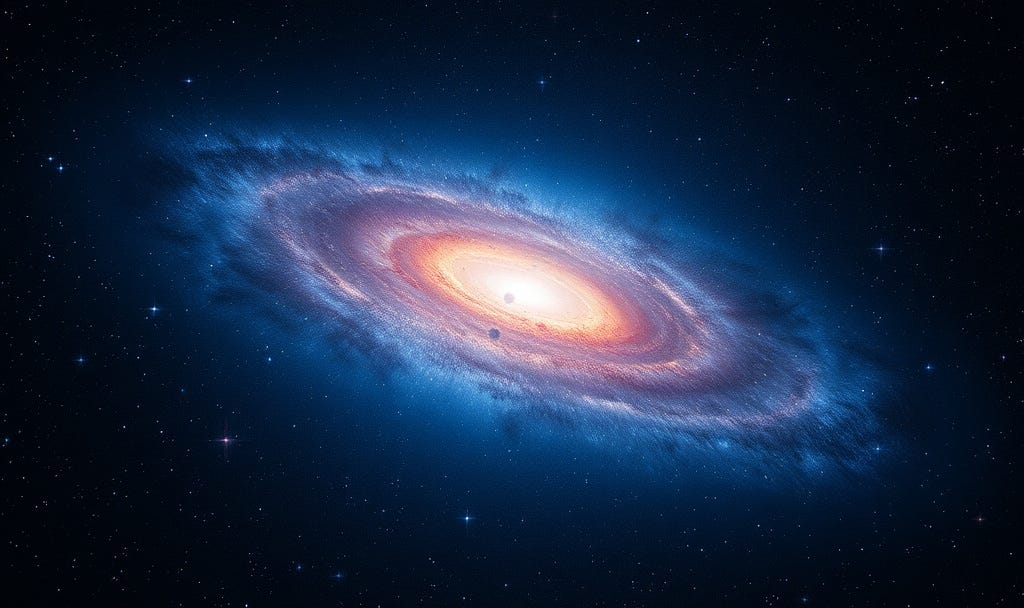
Thanks to the James Webb Space Telescope and the Hubble Telescope, we know that our solar system is nothing but a speck in one of multiple “arms” of our galaxy, which consists of millions of stars and solar systems. And what’s more, our Milky Way Galaxy is just one out of 100 billion that we know of.
Let’s face it, we are far less significant than the people of “Whoville” in the Dr. Seuss story, “Horton Hears a Who.” Earth itself is little more than a microbe of dust within millions and billions of pieces of dust flying through the void of space. What keeps God from losing track of our world in such an expanse?
Nothing!
When we realize just how small we are within the vastness of creation, it is astonishing to consider that He would care about us at all. And then I have to ask my second question, “What does He stand to gain from this deal?” What indeed?
Here is the only answer I can come up with: Nothing! When God the Father sent His Son, our Savior, Jesus, to suffer our punishment for sin in our place, He stood to gain nothing – absolutely nothing. As Jehovah God, the “self-existent One,” who dwells outside of all time, space, and matter, He needs nothing that He cannot create for Himself.
Seriously, I am astounded that God would send anyone or do anything to save humanity at all. And what is even more astounding is that, with His foreknowledge (as only the true God would have), He knew that the majority of humanity would reject the precious sacrifice of His Son for their salvation, yet the Father sent Jesus anyway.
Only One Reason
There can only be one reason that such an all-powerful, superior, transcendent being who exists outside of all we depend on for life and sustenance would come to save us – because He loves us. Why would He love such flawed, rebellious microbes in the universe? Why? Because in creation, God became our Father. Just as Jesus taught us to pray, “Our Father who is in heaven…”
We may be “microbial specks” flying through the universe on a little bit larger microbial planet, but we can grasp the intensity and power of a parent’s love. Before a child has a chance to do anything to earn their parents’ love, they are loved completely. The reason is that that kind of love is never based upon their child’s performance, giftedness, perfection, or even appearance, but solely because they are your very own.
How many parents have said, as they held their newborn child for the first time, “I would give my life for you.”? Well, that is just what God the Father did for His children through His only begotten Son, so that we would “not perish, but have everlasting life” (John 3:16-17).
Everything!
As the Apostle Paul wrote in 2 Corinthians 5:19, “… God was reconciling the world to himself in Christ, not counting men’s sins against them…” (NIV84). What response is worthy of such a priceless gift? I can only think of one response: Everything! In other words, saying, “I will love and live for You, Father, for the rest of my life.”

As Jesus began His earthly ministry, his message was, “Repent for the Kingdom of Heaven is near.” (Matt. 417). “Repent” was the message He gave to His disciples when He sent them out ahead of Him (Mark 6:12).
Paul’s explanation in the book of Acts provided further explanation of repentance: “I preached that they should repent and turn to God and prove their repentance by their deeds.” (Acts 26:20). The “deeds” do not save us; they reveal a life that has chosen to follow Jesus with all their heart, soul, mind, and strength.
The good news is, “He saved us, not because of righteous things we had done, but because of his mercy.” Titus 3:5.
Last Question
The sinful and lost state of this world moved the Father’s heart to “reconcile the world to Himself” through Christ’s sacrifice. And now we have a crucial decision to make – What will you do with such a priceless gift? “I tell you, now is the time of God’s favor, now is the day of salvation.” (2 Cor. 6:2). My last question, “Why wouldn’t you do that – today?”
© Pastor Timothy B. White, December 23, 2025. All rights surrendered to the service of my heavenly Father, who sent His one and only Son to save me and adopt me as His son.